
When an established, mid-sized company reaches the point of reorganization, leadership is rarely operating from a position of calm clarity. Pressures tend to converge from multiple directions. First, legacy structures begin to strain under rising demands for growth and performance. Second, competitive intensity increases, and internal friction becomes more visible. Third, the CEO must answer to the board and investors — stakeholders who often arrive with predefined assumptions about which structural adjustments will deliver fast and efficient results.
Navigating Investor Relations During Reorganizations
Topics: Organization Design, Adaptive Organization Design, Investor Relations
What a Good Organization Design Can Do for You – and What Not
Organization design is often approached with a sense of anticipation. New structures are drawn, roles clarified, operating models updated—and suddenly collaboration, engagement, and performance are expected to improve. Sometimes they do. Often, the picture is mixed—progress in some areas, persistent friction in others. Not because organization design lacks power, but because its role is misunderstood.
Topics: Business Transformation, Organization Design, Adaptive Organization Design, OrgDesign
Organization Design in 2026: Turning Complexity into Dynamic Focus
Happy 2026 from LC GLOBAL®!
Entering a new year always invites reflection, and 2025 was an extraordinary chapter—one that reaffirmed how powerful organization design can be when companies commit to clarity, collaboration, and meaningful engagement. The growth we experienced was sensational, but what mattered most were the moments when leaders and teams realized that complexity does not have to be chaotic, and that adaptability can foster both performance and enjoyment.
Topics: Business Transformation, Change Leadership, Adaptive Organization Design, OrgDesign
The Cost of Silence: How Toxicity Blocks Change
In many transformation meetings, the same pattern repeats itself. Leaders ask for feedback. A few safe comments are offered. Heads nod. Decisions are confirmed. Once the meeting ends, the real conversation begins—in hallways, side messages, or private calls. Concerns are voiced where they carry no risk—and no influence.
Topics: Adaptive Organization Design, OrgDesign, Organizational Silence
How Agentic AI Can Shape Your Organization Design
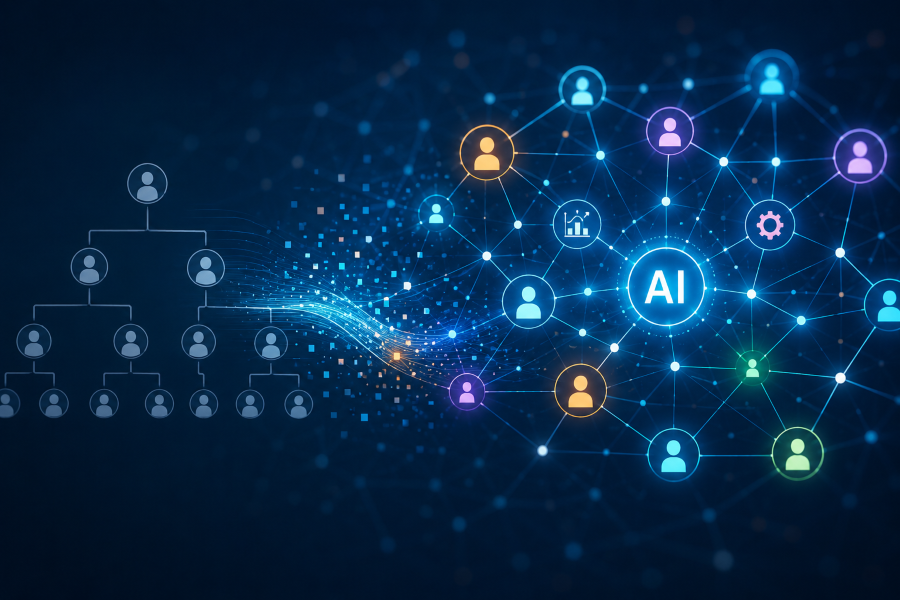
Artificial intelligence is no longer a tool exclusively used to execute predefined tasks. In many organizations, it has become an active participant in shaping how work gets done—and increasingly, how organizations themselves are designed. The transformation is unfolding quietly and unevenly, but its direction is clear: As AI becomes more agentic—autonomous, proactive, and self-learning—it begins to mediate the very structures through which work, collaboration, and capability evolve.
Topics: Organization Desgin, Adaptive Organization Design, AI, OrgDesign, Agentic AI
Navigating Uneven Progress in Organization Design
In adaptive organization design, the broader destination is often clear. Our clients typically set out to build flatter structures, foster stronger collaboration, and create the conditions for adaptability and engagement. Yet while the goals may be well defined, the path to reaching them rarely unfolds in a straight line. The development pace of people, processes, and workflows differs widely, and the granular end state is never fully visible at the beginning. What unfolds instead is a journey where even the underlying processes, skill sets, and workflows continue to emerge throughout the transformation. Along the way, unexpected challenges surface. Departments progress at uneven speeds, leaders lag behind teams, and skepticism from employees lingers longer than anticipated. For clients and stakeholders alike, it is crucial to recognize that these challenges are not flaws in the process. They are inherent to collaborative approaches that embrace co-creation and shared ownership. In other words, they are part of the process—and without working through them, meaningful change cannot occur. In this article, we explore the most common forms of uneven progress and what it takes to navigate them effectively.
Topics: Leadership, Organization Desgin, Adaptive Organization Design, OrgDesign
Structure Drives Behavior: Dr. Erika Jacobi on the OrgDesign Podcast
At LC GLOBAL®, we are proud to share that our very own Dr. Erika Jacobi, Founder and Executive Director, was recently invited to join The Org Design Podcast, hosted by Amy Springer and Damian Bramanis and powered by Functionly. This podcast brings together thought leaders and practitioners who are reshaping how organizations are designed to meet the challenges of today’s fast-changing environment. In this special episode, Dr. Jacobi explores why structure drives behavior and how thoughtful design can help organizations adapt, grow, and thrive. The full conversation is available to watch further down in this article—but first, we want to highlight some of the key insights she shared and what they mean for leaders navigating transformation today.
Topics: Leadership, Organization Desgin, Adaptive Organization Design, OrgDesign
AI Tools for Organization Design
The Organization Design Forum offered an insightful session on the of role AI in Organization Design last week.
The use of AI has become a central question in boardrooms and executive meetings. Evidently, companies must find ways of positioning themselves around AI as a new opportunity to innovate services and increase effectiveness. Why should the field of Organization Design, which typically assists companies in such efforts, be any different?
Topics: Organization Design, Adaptive Organization Design, AI
'Hurry, Let's Wait' And Other Signs That Your Company Is Not Agile
Topics: Culture Of Innovation, Agile Organization Design, Agile, Enterprise Agility, Adaptive Organization Design