

When an established, mid-sized company reaches the point of reorganization, leadership is rarely operating from a position of calm clarity. Pressures tend to converge from multiple directions. First, legacy structures begin to strain under rising demands for growth and performance. Second, competitive intensity increases, and internal friction becomes more visible. Third, the CEO must answer to the board and investors — stakeholders who often arrive with predefined assumptions about which structural adjustments will deliver fast and efficient results.
The Weight of Legacy Patterns
The legacy symptoms an organization typically faces at that point tend to emerge in a predictable configuration. Revenue that once felt stable shows visible dents. Decision-making slows. Cross-functional coordination becomes heavy. Strategic initiatives stall. The same bottlenecks reassert themselves in day-to-day operations, limiting responsiveness and slowing execution. As complexity accumulates, adaptability is not simply reduced — it is practically engineered out of the system. Turnover rises, while remaining employees quietly question the company’s direction.
Initial explanation attempts often center on performance gaps. Perhaps certain leaders are no longer effective. Perhaps accountability must tighten. Perhaps cost control must intensify.
As redesign discussions deepen, however, a more operational reality emerges. The organization operates with a design developed for earlier stages and business conditions that no longer apply. The architecture of the system now generates the friction, underperformance, and distorted decisions that are frequently attributed to individuals. As a result, eliminating or replacing perceived underperformers rarely produces the desired effect. A system designed for a different reality reproduces friction and underperformance on auto-repeat, even with new leaders or team members.
Investor Relations: When Adaptive Transformation Enters the Capital Arena
When the CEO and ELT recognize that the current structure no longer supports the company’s strategic demands, internal commitment usually forms around a more systemic, modern, and adaptive redesign. While this marks a decisive step forward, that momentum often begins to fade once the concrete transformation plans enter the investor arena.
At its core, the conflict reflects competing value logic. One seeks immediate financial correction. The other seeks structural capability and people development. These priorities do not always align initially, and at times they directly compete.
Investors and boards typically evaluate reorganization through a capital-centered lens that emphasizes efficiency, predictability, and margin protection. Operational leadership evaluates it through an adaptability lens that prioritizes decision quality, dynamic collaboration, governance effectiveness, and long-term resilience.
The tension, therefore, is embedded in what each side treats as the primary driver of value.
The CEO’s Mandate in Reorganization Under Capital Pressure
If the CEO does not actively shape this crucial moment in the company’s investor relations, capital-driven logic can quickly dominate the process. Reorganization then narrows into a corrective maneuver focused on short-term financial performance rather than operational evolution designed to strengthen the enterprise’s long-term capacity.
To prevent this trajectory or an entire halt to the initiative, the CEO must assume a dual mandate: a deep systemic transformation internally and a powerful narrative alignment externally. That means long before the formal transformation journey begins, the CEO must align internal operational diagnosis with external capital expectations through mindful preparation and framing.
Practical steps for the CEO include:
- Model stability under external and internal pressure, signaling confidence across levels.
- Establish ongoing investor dialogue rather than relying on isolated justification moments.
- Sequence communication deliberately instead of reacting to ad-hoc pressure cycles.
- Build credibility early through smaller, visible wins to strengthen the CEO–investor relationship before major transformation discussions begin.
- Clarify and consistently communicate the operational root causes internally before entering investor negotiations, ensuring the diagnosis moves beyond surface-level performance indicators.
- Align the executive team around one coherent narrative, allowing clarity at the top to create a positive ripple effect throughout the organization and within investor dialogue.
- Assess leadership readiness and capability risk before announcing transformation efforts.
- Translate transformation needs into capital value language, demonstrating how structural evolution supports adaptability, decision velocity, and long-term enterprise resilience beyond short-term cost corrections.
- Define non-negotiables tied to future viability rather than short-term optics.
- Allow capital stakeholders time to absorb the new operational logic, recognizing that perspective shifts require patience and iteration.
- Maintain persistence through early resistance. Structural transformation rarely secures immediate consensus.
- Identify smaller steps that can move forward irrespective of investor hesitation.
- Recognize and highlight incremental wins to sustain internal momentum.
These practical steps point to a broader shift in responsibility. The CEO cannot remain a distant sponsor of transformational change. Reorganization demands active leadership at the highest level, and the role requires sustained engagement across domains.
Dynamic, Multi-Level Orchestration
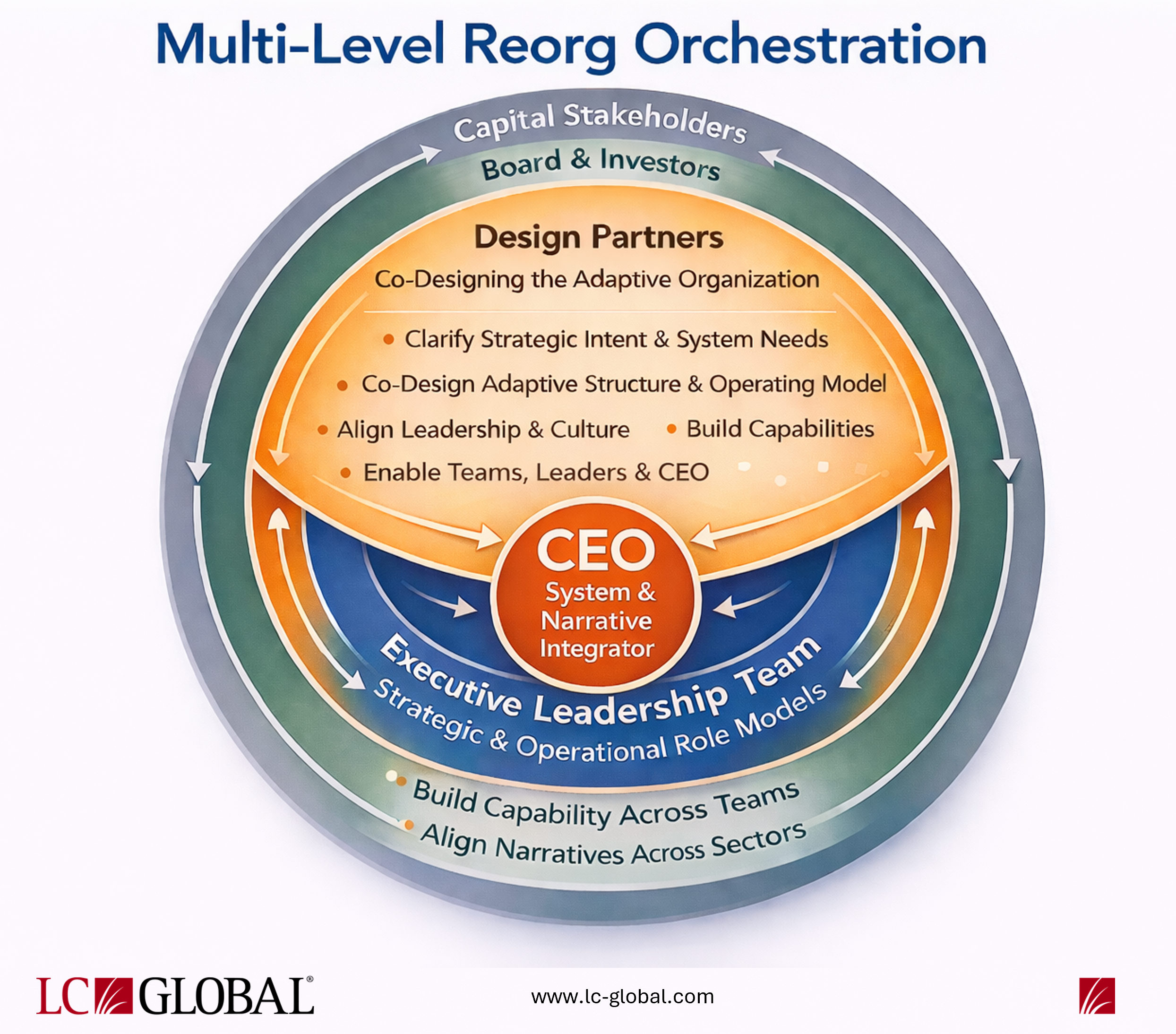
Transformational reorganization and navigating the underlying investor relationships thus becomes a coordinated effort across interconnected layers: the organization itself, the CEO and the executive team, the design partners facilitating the transformation, and the financial stakeholders, namely investors. The CEO remains at the center of this dynamic.
The external dimension requires consistent attention. The CEO must shape these conversations by translating the required operational evolution into capital terminology such as scalability, disciplined capital allocation, and long-term value protection. Board alignment must be cultivated around phased recalibration rather than immediate correction. Performance variability is framed not as failure but as a temporary consequence of structural strengthening.
At the same time, internal dynamics require equal attention. In close collaboration with the CEO and the ELT, design partners engage the enterprise in a deliberate, multi-layered process. Together, they clarify operational priorities and growth strategy, recalibrate decision rights and governance rhythms, surface informal power dynamics, and identify capability gaps that could undermine execution. This work includes the top team itself. Leadership behavior, mindset assumptions, and collaboration patterns evolve alongside operational changes. From there, operational excellence and adaptability are strengthened not only through redesigned structures but also through evolved leadership capacity, ensuring that the system and its leaders can carry the commitments made to capital stakeholders.
The central risk in transformational reorganization is desynchronization. If internal redesign advances without investor alignment, external pressure escalates, and the initiative risks narrowing into a cost exercise. If investor commitments are made without internal readiness, credibility among the members of the organization erodes, and legacy patterns persist.
Internal recalibration and investor alignment must therefore move in step. When dynamically synchronized, reorganization becomes more than a response to pressure. It becomes a deliberate evolution of operational capacity and investor expectations.
Ultimately, this multi-level synchronization across leadership, system design, and investor relations makes transformation operationally sustainable and strengthens both enterprise resilience and the quality of investor relationships.