
For a long time, AI adoption in organizations largely meant introducing tools such as ChatGPT, Gemini, or Copilot into the workplace. Organizations focused on access, experimentation, governance, and enablement. Individuals integrated AI into parts of their daily work, and companies tried to understand where productivity gains could be realized. In many ways, AI initially entered organizations as an additional layer within existing workflows rather than as a catalyst for broader organizational change.
During this important phase, organizations took the time to experiment with AI tools, build familiarity, and better understand where AI could create value. Yet much of the conversation during that phase remained centered around the tools themselves — who should use them, how they should be governed, and where they could support efficiency or productivity improvements.
What we are beginning to see now, however, feels fundamentally different.
Increasingly, organizations are moving beyond isolated use cases and individual productivity discussions. The conversation — in many companies — is rapidly shifting toward workflows, operating models, collaboration structures, and the broader implications AI may have for how work itself is organized. Rather than simply asking where AI can be inserted into existing processes, more organizations are beginning to ask what the future organization should look like once AI becomes more deeply embedded into the execution of work.
From AI Add-Ons to Agentic Execution
The 2026 Stanford University AI Index Report reveals a broader shift already reshaping entire organizations. According to the report, AI agent performance on OSWorld — a benchmark testing agents on real computer tasks across operating systems — increased from roughly 12% to 66.3% within a year, bringing performance within six percentage points of human levels. At the same time, AI models are increasingly moving into professional domains such as tax, mortgage processing, corporate finance, and legal reasoning, where leading systems already achieve performance levels ranging from 60% to 90%.
The speed at which AI capabilities are evolving changes the strategic importance of the technology itself. According to the Stanford report, frontier AI models gained approximately 30 percentage points within a single year on Humanity’s Last Exam, a benchmark specifically designed to remain difficult for AI systems and favorable toward human experts. In some domains, AI systems are already surpassing human-level performance.
The implications for organizations are significant. As more companies begin using AI agents to execute parts of their workflows faster, more consistently, and often more effectively than humans, competitive pressure naturally increases across industries. Organizations with fragmented workflows, slow decision-making, or broken productivity lines may find themselves under growing pressure to adapt more quickly by integrating agentic AI into how work is executed and coordinated across the business.
Once organizations move beyond using AI to support isolated tasks and begin coordinating activities, initiating actions, and operating across workflows, they must start thinking more broadly about governance and how their organization design — including workflows, operating models, leadership structures, and governance — can hold it all together as a unique, dynamic system.
What AI Leaders Do Differently
The 2026 PwC AI Performance Report highlights a growing divide between organizations experimenting with AI and those translating AI into measurable business outcomes.
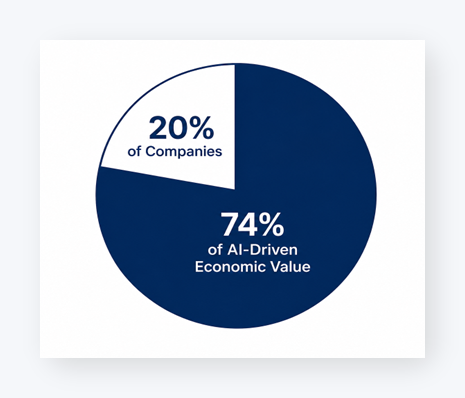
According to the study, approximately 20% of organizations capture nearly three-quarters of AI’s economic gains. What differentiates these organizations is not simply access to more advanced models or tools. The strongest performers are significantly more likely to redesign workflows around AI rather than simply layering AI onto existing processes. In other words, AI leaders use AI transformation as an opportunity to redesign their broader organization.
The findings include:
- AI leaders are approximately 2–3 times more likely to use AI to identify growth opportunities and rethink their business models.
- They are twice as likely to redesign workflows around AI rather than simply adding AI tools to existing processes.
- They are nearly three times more likely to increase the number of decisions executed autonomously within defined guardrails.
While these differences may appear subtle on the surface, they ultimately reflect a fundamentally different approach to AI transformation.
Organization Design as a Strategic Capability
Companies reading the PwC findings might easily jump to the conclusion that what they need to move ahead of the bell curve is an Organization Design team or a one-off redesign initiative. While that thought is tempting — and potentially initially helpful — it will likely not have the desired long-term effect for a simple reason: AI evolves too fast.
The broader challenge emerging during AI transformation is not simply that organizations must redesign to facilitate the intersections between human and AI workflows, but that Organization Design itself must become a far more dynamic, continuous, and embedded organizational capability. This creates growing pressure for organizations to adapt more fluidly and consistently over time, allowing workflows, structures, leadership, governance, and capabilities to continuously evolve alongside changing technological realities.
That means redesign becomes less of an occasional transformation effort and more part of how the organization naturally operates. It also means organizational redesign becomes less centralized and increasingly integrated into the broader organizational system itself.
This equally requires a shift in how organizations think about their:
-
Culture
-
Leadership
-
Teams and Collaboration
-
Decision-making
-
HR and OD
-
ELT structures and interconnections
These shifts help organizations move beyond redesigning for a future-state structure alone and toward building a unique, effective, adaptive, and dynamic organizational system capable of evolving continuously alongside agentic AI itself.
Closing the Gap: The Power of a Unique System
While AI transformation requires considerable thought, energy, experimentation, and continuous adaptation, it also creates a rare opportunity. Organizations can use this shift not simply to implement new technologies, but to rethink how they create value altogether.
The real opportunity lies in building a more unique organizational system. That includes creative business models, people systems, leadership structures, customer experiences, collaboration models, and human–AI interactions that competitors cannot easily replicate.
While organizations spent much of the past century pursuing optimization and standardization, many ultimately became increasingly similar in how they structured work, leadership, collaboration, and operations.
During periods of rapid change and intense uncertainty, however, a different reality emerges: More creative and unique systems allow organizations to attract outstanding talent and remain dynamic as technologies and markets continue evolving.
With this in mind, AI transformation, if approached intentionally, becomes far more than a technology shift. It becomes an opportunity to shape a more adaptive, engaging, and differentiated organization from the inside out.