
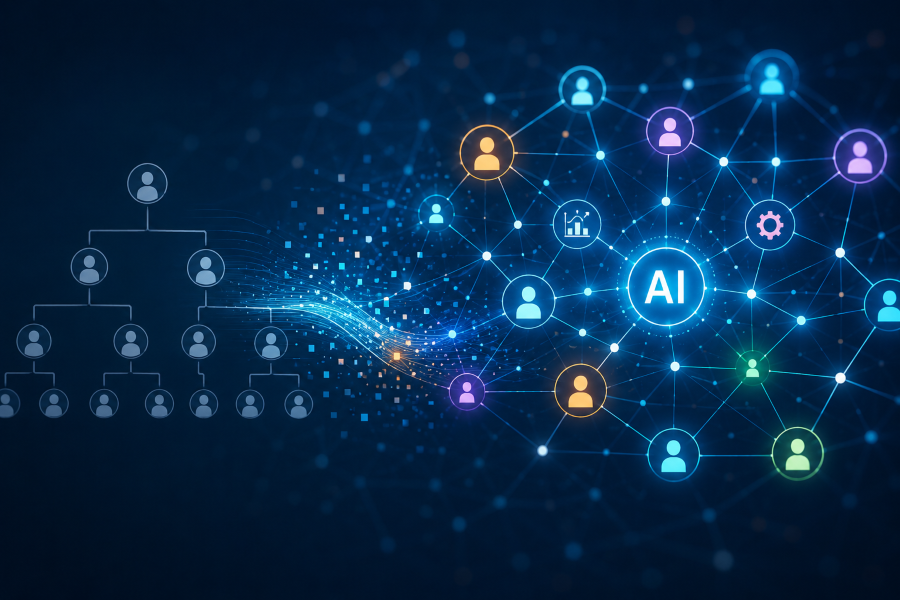
Many organizations are currently focused on introducing artificial intelligence into their operations. New tools are being added, pilots are being launched, and use cases are expanding across functions. Yet despite this activity, the overall structure of work often remains largely unchanged. What is beginning to emerge, however, is a different approach. Some organizations are moving beyond adding AI and are starting to redesign work around it. This shift marks a transition toward AI-centric organization design, where workflows, roles, and decision-making are reconfigured with AI as an integral component rather than an external addition.
A recent study by PwC (2026) reinforces this shift. Based on responses from over 1,200 senior executives, it highlights a growing divide between organizations that translate AI into measurable outcomes and those that remain in experimentation mode. A relatively small group of companies captures the majority of AI’s economic value, while others continue to struggle to scale beyond pilots.
The difference is not access to technology. It is how AI is used.
Organizations that achieve stronger results do not treat AI as a layer added to existing operations. They use it to rethink how work is structured, how decisions are made, and how value is created. One data point from the study makes this particularly visible: These organizations are twice as likely to redesign workflows to incorporate AI rather than simply adding AI tools.
The implications go beyond performance metrics. They point to a deeper shift in how organizations need to be designed.
From Adding AI to Redesigning Work
Many organizations still approach AI by adding it into existing processes. A tool is introduced with the expectation that it will automate tasks or improve efficiency. While this can lead to incremental gains, it rarely changes the overall system. The workflow remains intact, and with it, the limitations of how work is organized.
Organizations that move further treat workflows as the starting point. Instead of asking where AI can be inserted, they ask how work would be structured if AI were an integral part from the outset. This leads to more fundamental redesign. Tasks are regrouped, decision points shift, and interfaces between teams are reconsidered. In some cases, processes are rebuilt entirely rather than optimized.
This is where the shift toward AI-centric organization design begins. Work is no longer defined independently of the technology that enables it. Instead, workflows evolve as integrated human and AI systems.
Designing Human–AI Collaboration
As workflows are redesigned around AI, a second shift becomes visible—one that fundamentally changes the scope of organization design. Not all AI has the same implications for how organizations need to be structured.
Traditional AI applications tend to support specific tasks within a workflow. They assist with analysis, automate defined steps, or improve decision quality within an existing structure. In this form, AI remains embedded within workflows designed for human execution.
Agentic AI introduces a different dynamic. It can initiate actions, coordinate across multiple steps, and operate with a degree of autonomy within defined guardrails. Rather than supporting work, it begins to execute and orchestrate it across workflows.
This is where the design challenge becomes more explicit. Organizations have gone through similar moments during earlier waves of digital transformation, where technology either remained an add-on or reshaped how the business operated. The difference now is the level of autonomy. With agentic AI, organizations are no longer only redesigning workflows—they are designing collaboration between human and non-human actors.
This requires a level of clarity that goes beyond traditional process design. The interaction between human and agentic AI needs to be defined as deliberately as collaboration between people. Who initiates work? Where are decisions made? When does a human step in, and when does the system operate independently? These questions are no longer technical—they are core organization design questions.
Several design shifts follow from this.
Workflows become the primary reference point for design decisions. Instead of starting with structure, organizations need to understand how work flows from input to outcome and how AI reshapes that flow. Structure then follows from these insights.
Decision-making moves closer to the system. Routine, data-driven decisions are increasingly embedded within workflows, and with the rise of agentic AI, entire sequences of decisions can be executed within defined parameters. Human involvement shifts toward exceptions, complex judgment, and strategic direction. This requires clarity around accountability and governance, as decision authority becomes more distributed.
Roles and capabilities evolve accordingly. As agentic AI takes on more coordination and execution across workflows, human roles shift further toward oversight, interpretation, and system-level thinking. This is not only a reskilling challenge. Roles themselves need to be redefined based on future workflows, and the interfaces between human and AI need to be made explicit. Clear responsibilities, decision rights, and interaction points become as critical in human–AI collaboration as they have always been in human–human collaboration.
Designing for Growth, Not Just Efficiency
Another pattern becomes visible when looking at organizations that are further along. They do not position AI primarily as a productivity tool. Instead, they use it to identify and pursue new opportunities and to rethink their business models.
This orientation has direct implications for organization design. If AI is framed around efficiency, design efforts tend to focus on optimization and cost reduction. If AI is framed around growth, design needs to support exploration, experimentation, and collaboration across traditional boundaries.
This often leads to more fluid structures, cross-functional ways of working, and stronger alignment at the leadership level. Organization design in this context is less about stabilizing the current state and more about enabling the organization to evolve.
The Role of Trust and Governance
As AI becomes more deeply embedded in workflows, trust becomes a central factor. Organizations that are further along tend to invest in governance mechanisms that ensure AI operates within defined parameters. This includes responsible AI frameworks and cross-functional oversight.
Trust directly influences how AI is used. If employees do not trust the system, they will bypass it or replicate work manually, reducing both efficiency and effectiveness. Designing for trust therefore means embedding governance into workflows, clarifying accountability, and ensuring transparency in how decisions are made.
Closing the Gap
The gap between organizations that effectively leverage AI and those that do not is likely to widen if current patterns persist. The difference lies less in the technology itself and more in how organizations approach its role within the system. Organizations that move ahead do not treat AI as something to be added. They use it to rethink how work, decisions, and value creation are organized—and how humans and increasingly autonomous systems collaborate within that design.
For many, this requires a shift in perspective—from introducing AI into existing structures to designing the organization around it.
The question is no longer whether to add AI. It is whether organizations are prepared to redesign themselves to fully realize its potential.