

Organizations have become increasingly open to inviting employees to participate in shaping change. Whether introducing AI, redesigning operating models for adaptability, or reorganizing teams, many companies recognize the value of involving the people who understand how work gets done. And for good reason. Employees bring operational knowledge, challenge assumptions, identify obstacles, and contribute ideas that may otherwise never reach decision-makers. Their involvement can strengthen commitment and produce solutions that better reflect business realities.
However, there is an underlying paradox.
Organizations may give employees considerable influence over how a transformation is implemented, only to return them to an operating model in which they have little authority to make everyday decisions.
The transformation may have been highly participatory. Yet the organization itself hasn't necessarily become faster, more responsive, or more adaptable. And despite their involvement, employees may have gained little lasting influence over everyday decisions.
This disconnect can undermine trust, discourage initiative, and ultimately slow the organization down. Given the mismatch between desired results and outcomes, perhaps it's time to rethink the role of employee influence in organization design.
Two Forms of Employee Influence
Employee influence can take different forms. Two are particularly relevant to organization design.
Participatory Influence: Shaping a Particular Change
Employees contribute to decisions surrounding a specific initiative, such as an organizational redesign, AI implementation, or process transformation.
- Purpose: Improve the quality and acceptance of a particular change.
- How it works: Employees share operational knowledge, challenge assumptions, and help develop solutions.
- Authority and duration: Influence is generally limited to the initiative; final decisions may remain with leadership.
-
Organizational benefit: Better-informed solutions, greater commitment, and potentially smoother implementation.
Operationalized Influence: Shaping Everyday Decisions
Employees have ongoing access to relevant information and clearly defined authority to make decisions within their responsibilities.
Purpose: Enable timely, informed decisions and continuous adaptability.
How it works: Information flows, decision rights, and coordination mechanisms support decentralized decisions.
Authority and duration: Decision-making power is distributed according to responsibilities and embedded in everyday work.
Organizational benefit: Greater responsiveness, fewer unnecessary escalations, and faster adjustment to changing conditions.
Both forms are valuable, but they accomplish different things. Participatory influence can improve how an organization changes. Operationalized influence can change how effectively and responsively it operates.
A participatory redesign may produce a new structure without changing who receives information, who makes decisions, or how quickly teams can act. That is where organization design needs to go beyond inviting employees to participate.
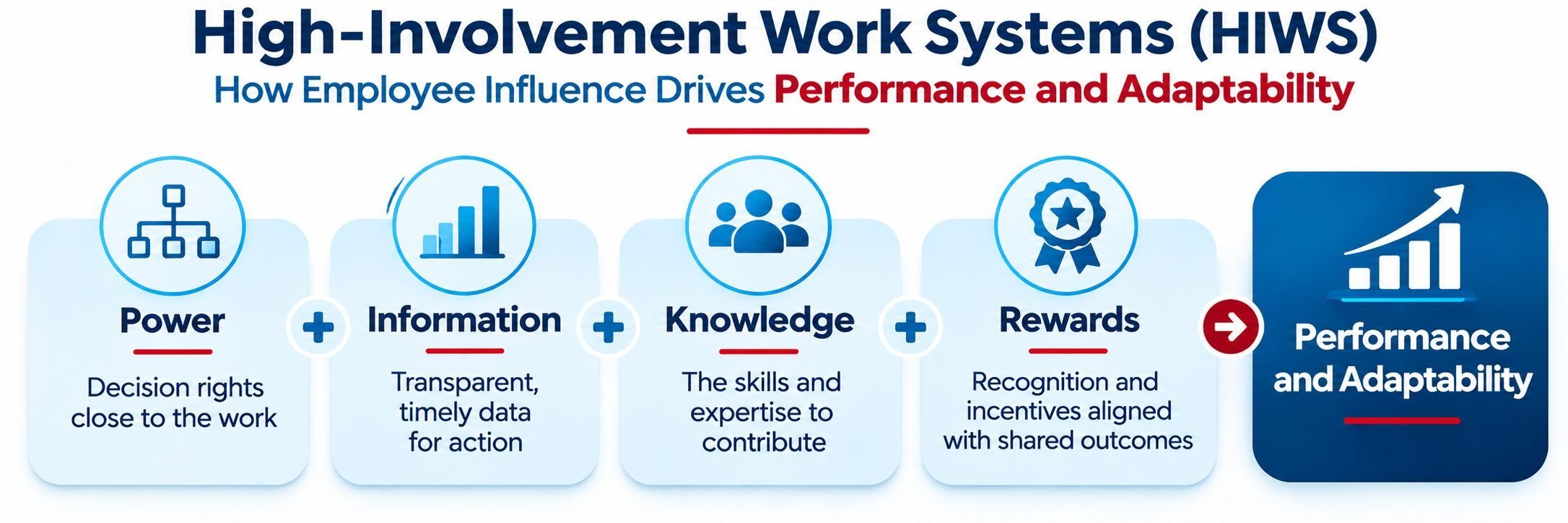
Designing High-Involvement Work into the Operating Model
The principles of high-involvement work systems help explain what operationalized influence requires. Rather than relying on occasional opportunities to contribute, these systems connect decision-making power with the information, knowledge, and rewards people need to exercise it. Here are some organization design strategies that can pave the way.
Information flows toward the work. In a high-involvement work system, customer insights, performance indicators, and strategic priorities proactively reach the people who can act on them, including across functional boundaries.
Decision rights match responsibilities. Employees and teams know what they can decide independently, when collaboration is needed, and what requires executive or specialist input. Sound workflows allow those decisions to happen without unnecessary escalation.
Capabilities, accountability, and rewards reinforce autonomy. Employees have the business understanding to interpret information and act responsibly. Recognition and incentives support sound judgment and cross-functional collaboration, not simply compliance or upward referral.
The organization establishes ways to learn from operational experience. It is the organization's responsibility to revisit assumptions and adjust decisions and workflows as circumstances change.
These elements are closely interdependent, and their effectiveness depends on how well they work together. Providing information without decision-making authority creates frustration; distributing authority without adequate information introduces risk; and decentralizing decisions without effective coordination can fragment the organization.
Developing a high-involvement work system doesn't mean decentralizing everything. The goal is to put decisions where they can be made most effectively, with the right boundaries and accountability.
High-Involvement Work Systems: Two Approaches
Allstate: Moving Decisions Closer to the Work
Allstate's Claims division offers a compelling example of how high-involvement work principles can reshape an operating model. The company has fundamentally changed how work is planned, decisions are made, and results are measured.
Rather than heavily prescribing annual projects, leadership shifted to setting strategic objectives grounded in the company's purpose, value proposition, and core values. These provide the direction and boundaries within which cross-functional teams can operate independently. Teams use customer data, business priorities, and shared values to identify opportunities, collectively prioritize initiatives, experiment with solutions, and continuously adjust their approaches.
This approach enables decentralized decision-making while keeping teams aligned around shared, purpose-driven outcomes rather than prescribed activities or hierarchical reporting lines.
And the results are tangible. According to a 2023 MIT CISR briefing, the proportion of claims submitted through self-service channels increased from 5% to 38% in 2022. By 2023, the division also reported improvements in customer experience, payout accuracy, and operational efficiency, generating millions of dollars in annual savings.
AGCO: Employees Developing Agentic AI to Improve Their Work
Agricultural machinery manufacturer AGCO offers another example, illustrating a different approach. Instead of leaving AI development entirely to a central technology function, it enabled employees to identify operational problems and build AI agents with technical support, training, and governance. More than 900 employees volunteered.
According to a 2026 Microsoft case study, AI-assisted processes reduced some quality-review work from weeks to about an hour. AGCO doesn't necessarily demonstrate company-wide decentralization of decision rights. It does, however, illustrate employees gaining influence and support to improve their own work rather than waiting for centrally designed solutions.
These examples show two different possibilities: giving teams authority to respond and giving employees the means to improve operations. Both depend on how the organization is designed to support action.
Why Employee Influence Is So Difficult to Operationalize
If more distributed decision-making can improve responsiveness, why do so many organizations struggle to put it into practice?
Formal authority and everyday behavior don't always move together. A 2024 Administrative Science Quarterly study found that even after an organization decentralized authority, managers sometimes continued directing decisions while employees remained accustomed to seeking approval.
The obstacles are familiar. Managers may advocate empowerment but intervene when decisions matter. Employees may receive new responsibilities without clear decision boundaries or the information needed to act. Incentives may reward caution, compliance, and escalation rather than informed initiative. Years of hierarchical habits can make autonomy uncomfortable on both sides.
These aren't just structural problems. A 2024 study involving 5,807 individuals across 144 companies also found that the benefits of decentralized authority depended significantly on empowering leadership behavior.
In other words, an organization cannot become genuinely decentralized on paper while continuing to operate hierarchically in practice. Sustaining influence requires alignment between the operating model, leadership behavior, information access, and everyday expectations.
From Participation to High-Involvement Work Systems
Moving toward high-involvement work systems doesn't require transforming every decision-making process overnight. It starts with identifying where unnecessary approvals, information bottlenecks, or established leadership habits prevent people from acting effectively.
From there, organizations can begin redistributing selected decision rights, improving access to information, and giving teams room to exercise their authority within clear boundaries. Small pilots offer an opportunity to test new arrangements, learn from experience, and build confidence on both sides.
Importantly, this also requires a shift in organizational thinking: from leadership hierarchies to end-to-end workflows, from rewarding individual leadership performance to recognizing collective results, and from focusing primarily on long-term goals to enabling incremental improvements every day.
To achieve this, leaders must change their behavior and grow into new roles, while teams build confidence, capabilities, and shared accountability to exercise greater autonomy. Performance expectations and rewards must then reinforce these new ways of working. Otherwise, even well-designed improvements risk being pulled back into familiar hierarchical patterns.
Ultimately, employee influence is not the end goal. Faster decisions, higher productivity, greater business impact, and continuous adaptability are. Achieving these outcomes requires more than isolated participation initiatives. It requires high-involvement work systems that systematically distribute information, decision-making authority, and accountability across the organization.
The real challenge for leaders is to stop treating employee influence as an occasional opportunity and start designing it as a permanent organizational capability.